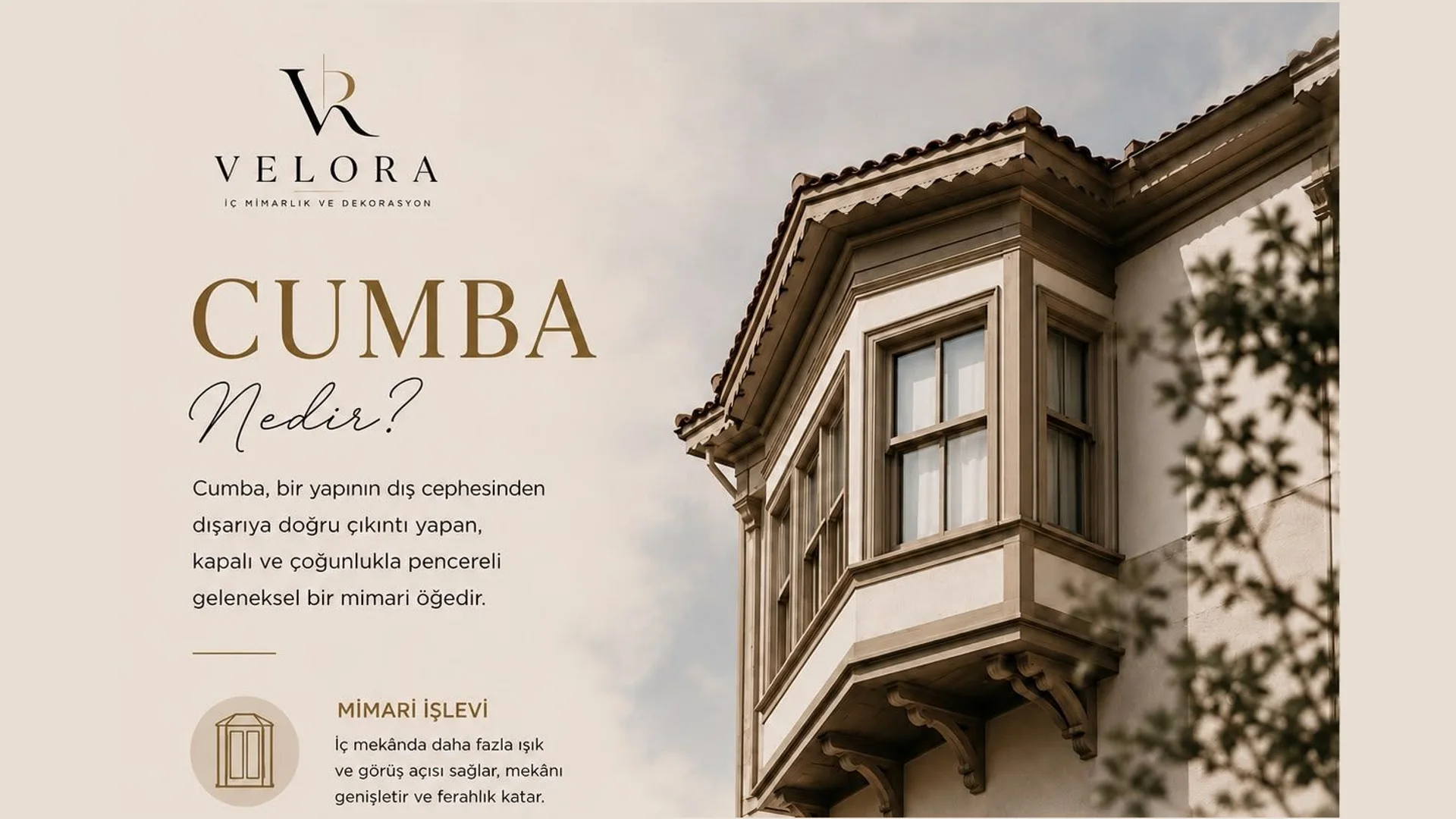
A closed, usually glazed element that projects out from the façade — a hallmark of traditional architecture.
A bay window, or cumba in Turkish, is a closed and usually glazed element that projects out from the façade of a building. It behaves like a room opening onto the street: it enlarges the interior, multiplies the light and gives the elevation rhythm.

Architectural function
It brings more light and a wider field of view indoors, enlarging the space and making it feel airy. Because it takes windows on three sides it receives light from different angles through the day, which keeps the seating area usable at any hour.
Historical value
Carried from the Ottoman period to the present, the bay is an important part of traditional Turkish architecture. On narrow streets it let the upper floor be wider than the one below, enlarging the living area while allowing the street to be watched without giving up privacy.
Aesthetic contribution
It gives the building elegance and creates rhythm and movement on the façade. Repeated along a straight street line, bays give the whole row character through their play of light and shadow.
Advantages
- More daylight
- A wider field of view
- Depth added to the room
- A traditional, timeless touch
The bay today
Contemporary housing reinterprets the bay with more glass and less ornament. Modern versions in timber and metal keep the traditional proportion while simplifying the detail.
Points to watch
- A bay cantilevers, so the structural calculation and reinforcement detailing must be careful.
- If insulation to the underside is forgotten, a cold bridge forms and condensation appears on the ceiling.
- Large glazed areas can overheat in summer; consider solar shading or low-emissivity glass.